
Why every batch is tested
When a compound problem shows up in the mould it is already too late: under-cure, scorch, hardness drift or adhesion failure mean scrap and downtime. That is why testing at Metekim is part of production, not an optional service. Every batch goes through rheometer and Mooney measurement; the mechanical and ageing tests your specification calls for are run to plan, and results are stored by batch number.
Test methods
| Test | Standard | What it tells you |
|---|---|---|
| Rheometer (cure characteristics) | ISO 6502 | ts2, t90, ML/MH: scorch safety and cure rate; first indicator of batch consistency |
| Mooney viscosity | ISO 289 | Processing behaviour: flow in calendering, extrusion and injection |
| Tensile strength and elongation at break | ISO 37 | Mechanical strength of the vulcanisate |
| Tear strength | ISO 34-1 | Tear resistance at demoulding and under dynamic load |
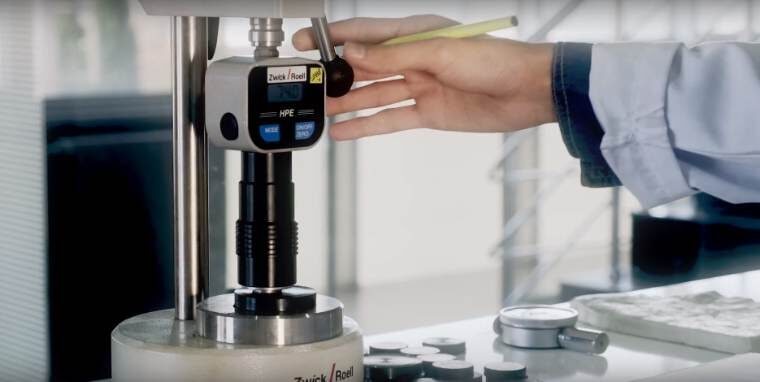
| Shore A hardness | ISO 48-4 | Specification hardness and tolerance |
| Heat ageing | ISO 188 | Property loss at temperature; service-life prediction |
Sample preparation and reporting
Test slabs are prepared on the laboratory press at the cure conditions in the specification; measurements are taken with calibrated instruments and reported on the batch certificate of analysis (COA). Additional tests specific to your specification (oil swelling, compression set, low-temperature behaviour) are planned on request.
The laboratory in recipe development
The laboratory is not only for control: trial compounds mixed at laboratory scale are measured with the same methods, and the recipe that meets the targets is transferred to series production. This shortens the sampling and approval cycle.
Quality management system
Metekim Kauçuk's quality management system is certified by DQS to IATF 16949:2016 and ISO 9001:2015. Measuring instruments follow a calibration programme; records are retained for traceability.
Frequently asked questions
Can I get a test report with every shipment?
Yes. A certificate of analysis (COA) is sent with every shipment on request, including the tests in your specification.
Can you test our own samples?
Sample testing is available for customers as part of recipe development and validation; we agree the scope together.
Which standards do you test to?
International methods, chiefly ISO 6502, ISO 289, ISO 37, ISO 34-1, ISO 48-4 and ISO 188.
Do you measure oil swelling or compression set?
Additional tests are planned when the specification requires them; details are agreed at quotation.