
What is cord fabric coating?
Cord fabric coating (also called frictioning or topping) presses rubber compound onto both faces of a textile cord fabric, such as nylon 6 / 6.6, polyester, aramid or cotton, on a calender. The resulting rubber-coated cord fabric is the reinforcement layer that gives a rubber part its dimensional stability and strength. Air-spring bellows, pneumatic diaphragms, reinforced hoses and belts and conveyor-belt plies cannot be made without it.
Three things decide coating quality: adhesion between fabric and rubber, consistency of layer thickness along the roll, and compatibility of the coating compound with the finished part's body compound. Metekim manages all three under one roof: we formulate the coating compound, run the calendering and coating on our own line, and test every batch in our laboratory.
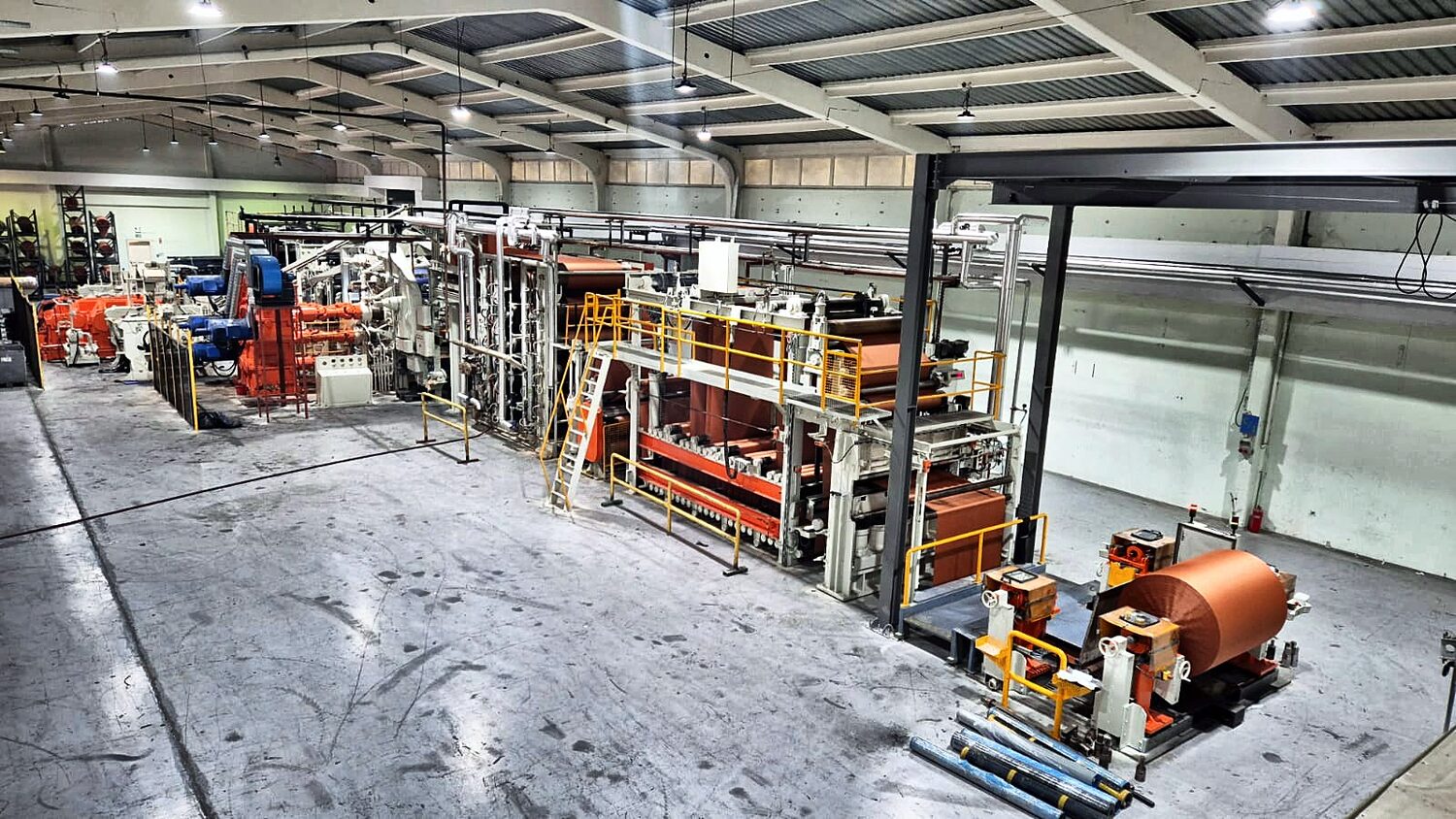
Our coating lines: Buzuluk and Troester
We coat cord fabric on two separate calender lines:
- Buzuluk calender line
- Troester coating line — the new line commissioned at our second plant to expand capacity
On both lines, fabric tension and calender gap control give repeatable thickness for thin and thick coatings alike; the coated fabric is wound with a liner so it reaches you clean and tack-free.
Applications
- Air-spring bellows (trucks, buses, trailers, industrial actuators)
- Pneumatic and hydraulic diaphragms and membranes
- Reinforced hose and belt plies
- Conveyor belting and technical coating applications
- Moulded technical parts that need a reinforcement layer
Coating compound: polymer and adhesion system
The coating compound is chosen from the same polymer family as the part's body compound so the layers fuse during vulcanisation. NR/SBR, CR, EPDM or NBR based coating compounds are formulated with an adhesion package matched to the fabric's RFL dip. Shore A hardness, Mooney viscosity and scorch safety are tuned to the calender process. We can also coat with the customer's own coating recipe.
Quality control
For every coating batch we check the coating compound's rheometer and Mooney values, and the coated fabric's weight per unit area and thickness; adhesion, tensile and tear values are measured in the laboratory. Records are kept by batch number and shipped with a certificate of analysis on request. Our quality system is certified to IATF 16949:2016 and ISO 9001:2015.
What we need for a quote
Fabric type and construction (for example nylon 6.6, yarn count and density), target total thickness or coating weight, coating compound specification (or the part's body compound), roll width and length, and monthly demand. Metekim can source the fabric, or we coat fabric supplied by you.
Frequently asked questions
Which cord fabrics do you coat?
Mainly RFL-dipped technical textiles: nylon 6 and 6.6, polyester and cotton. For special fabrics such as aramid we review the specification together.
Can we send our own fabric?
Yes. Customer-supplied fabric is coated with a compound matched to its properties. We can also source the fabric for you.
How is coating thickness controlled?
Calender gap and fabric tension are set on the line; thickness and weight per unit area are measured and recorded for every roll.
Is single-sided coating possible?
Yes. Single- or double-sided coating at different thicknesses is available depending on the application.